Harnessing the power of your tractor to set up a reliable irrigation system can revolutionize water management on your farm. By integrating standard implements, pumps, and hoses with a robust tractor, you can achieve precise water distribution, boost crop yields, and enhance overall efficiency. This guide will walk you through every stage—from assessing your tractor’s capabilities to installing and maintaining an effective irrigation setup.
Assessing Your Tractor’s Capabilities
Evaluating Horsepower and Torque
Before committing to any irrigation setup, confirm that your tractor delivers sufficient power to drive pumps and pull irrigation implements. A machine with at least 50–75 HP is typically suitable for small to medium plots. Examine the engine’s torque curve to ensure steady performance under load, especially when operating ground-driven pumps or large reel irrigators.
Hydraulic System Assessment
An efficient irrigation system often relies on auxiliary hydraulics to operate valves, winches, and reel mechanisms. Check the tractor’s hydraulic flow rate (GPM) and pressure (PSI). For most hydraulic-driven pivots or dribble bars, you’ll need 12–18 GPM at 2,500 PSI. Make sure all hydraulic connections are tight and free of leaks to maintain efficiency and safety.
PTO Compatibility
The Power Take-Off (PTO) is critical for running mechanical pumps or hose reels. Standard tractors offer a 540 RPM PTO output, while some models include 1,000 RPM for enhanced performance. Confirm that your irrigation pump or reel drive is compatible with the PTO speed and torque. If necessary, invest in a speed increaser or reducer to match the tractor’s output to the implement’s requirements.
Selecting and Preparing Irrigation Equipment
Choosing the Right Pump
- Submersible Pumps: Ideal for wells and boreholes, these pumps sit below the water level and offer high flow rates.
- Centrifugal Pumps: Mounted on a trailer or frame, they connect to the tractor’s PTO and are versatile for open-water sources.
- Diaphragm Pumps: Provide consistent pressure for drip and micro-irrigation systems, though they require periodic maintenance.
Hose and Pipe Selection
Select robust hoses that can withstand the tractor’s hydraulic pressure and abrasion from field debris. Lay out hoses with quick-connect fittings to facilitate rapid setup and tear-down. For long runs, consider using poly or PVC pipes supported by stakes to minimize sagging and prevent kinks that reduce water flow.
Irrigation Implements
- Reel Irrigators: Mounted on trailers, these units rewind hoses automatically. Ensure your tractor’s three-point hitch can support the weight and that the reel drive matches the PTO output.
- Traveling Sprinklers: Self-propelled units that follow a preset path. Verify wheel compatibility and secure hitch points for safe towing.
- Dribble Bars and Drip Lines: Ideal for orchards and vineyards. Use the tractor’s hydraulic outlets to roll out and reel in the distribution tubing efficiently.
Preparing the Field and Tractor
Field Layout and Leveling
Design your irrigation layout based on topography. Use GPS or laser leveling to create a uniform surface, reducing water pooling and runoff. Mark main headers, lateral lines, and valve boxes clearly with stakes to guide installation.
Installing Headers and Manifolds
Place the main header pipe near the water source and connect it to your pump outlet. Use robust flanged or grooved couplings to handle pressure fluctuations. Install control valves, pressure gauges, and filters close to the pump to protect downstream components.
Tractor Attachment and Safety Checks
- Inspect the three-point hitch for wear and secure all pins.
- Check implement weight distribution to avoid rear axle overload.
- Confirm all PTO guards, guards, and shields are intact and in place.
Perform a full safety audit, ensuring lights and reflectors are visible if you plan to transport equipment on public roads.
Installation and Operation
Priming and Starting the Pump
Begin by priming the pump according to manufacturer instructions. Close all discharge valves, engage the PTO at low RPM, and gradually open the inlet to fill the pump housing with water. Monitor pressure gauges to reach your target operating range—typically 30–60 PSI for sprinklers and 15–25 PSI for drip systems.
Hose Deployment and Rewind
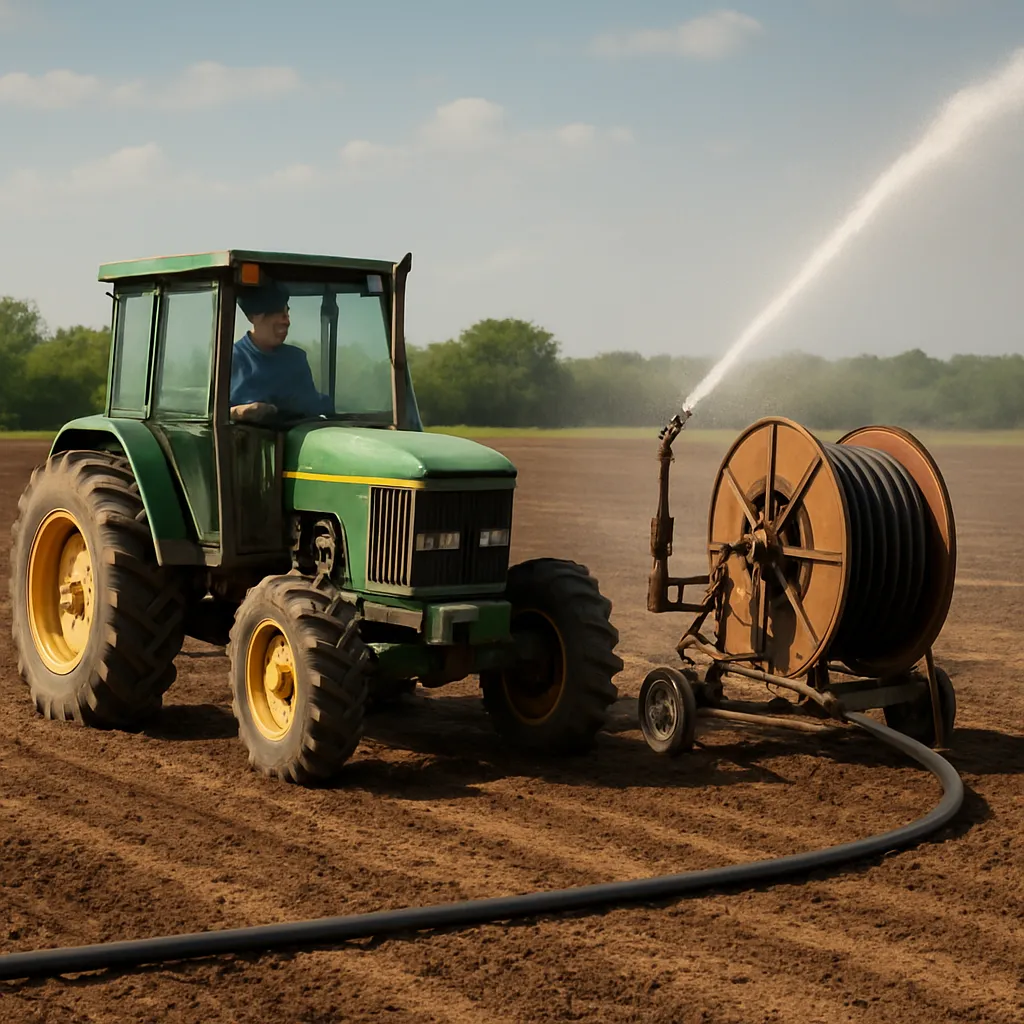
Attach the hose to the pump outlet using a quick-connect coupling. Drive the tractor forward at a steady pace to lay out the hose along the field perimeter or row. Engage the reel’s PTO drive to rewind after irrigation, maintaining tension to avoid hose tangles.
Calibrating Flow and Coverage
- Measure the output of each sprinkler or drip port over a set period—in gallons per minute or liters per hour.
- Adjust nozzle sizes or emitter flow rates to achieve uniform coverage. This calibration prevents dry spots and overwatering.
- Use a simple catch-can test grid to verify even water distribution across your field.
Maintenance and Optimization
Routine Tractor Maintenance
Keep your tractor in peak condition by following the manufacturer’s service intervals. Change engine oil, hydraulic fluid, and filters regularly. Inspect belts and hoses for cracks or wear. Proper upkeep ensures reliable operation when it’s time to irrigate.
Inspecting Pump and Lines
After each irrigation cycle, drain water from pumps and pipes to prevent freeze damage. Check for leaks at couplings and valve seals. Lubricate all moving parts, including reel bearings and valve stems, according to the recommended schedule.
Troubleshooting Common Issues
- Low Pressure: Confirm pump priming, clear clogged filters, and inspect for suction leaks.
- Uneven Coverage: Recalibrate nozzles, check line obstructions, and verify correct tractor speed during deployment.
- Hose Tangling: Ensure reel guides are aligned and maintain consistent PTO speed.
Enhancing System Efficiency
Invest in pressure regulators and flow meters to automate adjustments and minimize water waste. Adding a rain sensor or soil moisture probe can further optimize irrigation schedules, reducing operating time and fuel consumption. These upgrades not only conserve resources but also extend the lifespan of your equipment through reduced wear and tear.