Modern agriculture is changing rapidly, and tractors are at the center of this transformation. What used to be simple mechanical workhorses are now becoming connected, data-driven and increasingly autonomous machines. Farmers who follow the latest trends in tractor technology can improve productivity, reduce fuel consumption and work more precisely in the field. Platforms like farming.kim help growers understand how to select, configure and use modern tractors in a smart way, aligning machinery choices with agronomic and economic goals. As pressure grows to produce more food with fewer resources and lower environmental impact, the next generation of tractors is turning into a **strategic** investment, combining hardware, software and services into one integrated farming system.
From mechanical power to digital platforms
For decades, tractors were mainly about horsepower and durability. Today, they are evolving into **digital** platforms that connect the field, the operator and the farm office. Sensors, control units and communication modules turn the tractor into a rolling data hub. It collects information about position, fuel use, slip, implement performance and even soil conditions. This shift from pure mechanics to cyber-physical systems allows farms to manage operations with a level of insight that was impossible a generation ago.
The modern tractor cab now looks more like a cockpit than a simple driving seat. High-resolution touchscreens, configurable controls and advanced diagnostics give operators access to live information about each pass in the field. Many systems can be updated over the air, adding new functions or improving performance without the need to visit a workshop. The tractor becomes part of a broader **precision** agriculture strategy, speaking the same digital language as implements, drones, scouting tools and farm management software.
Precision guidance and advanced positioning
One of the most important technology trends is the adoption of satellite-based guidance systems. Using GPS and other global navigation satellite systems, modern tractors can follow straight or curved lines with sub-inch accuracy, especially when supported by RTK correction signals. This level of precision reduces overlaps and gaps in seeding, fertilizing and spraying, which directly saves input costs and improves yield uniformity.
Guidance systems span from simple light-bar aids to fully integrated steering that takes complete control of the tractor’s path. When combined with headland management, the system can automatically raise and lower implements, adjust speed and secure PTO operation during turns. Precision guidance helps operators maintain productivity over long days, reduces fatigue and allows less experienced drivers to achieve consistent results. In tight planting windows or under challenging weather, accuracy becomes a **competitive** advantage.
Autonomous and semi-autonomous operation
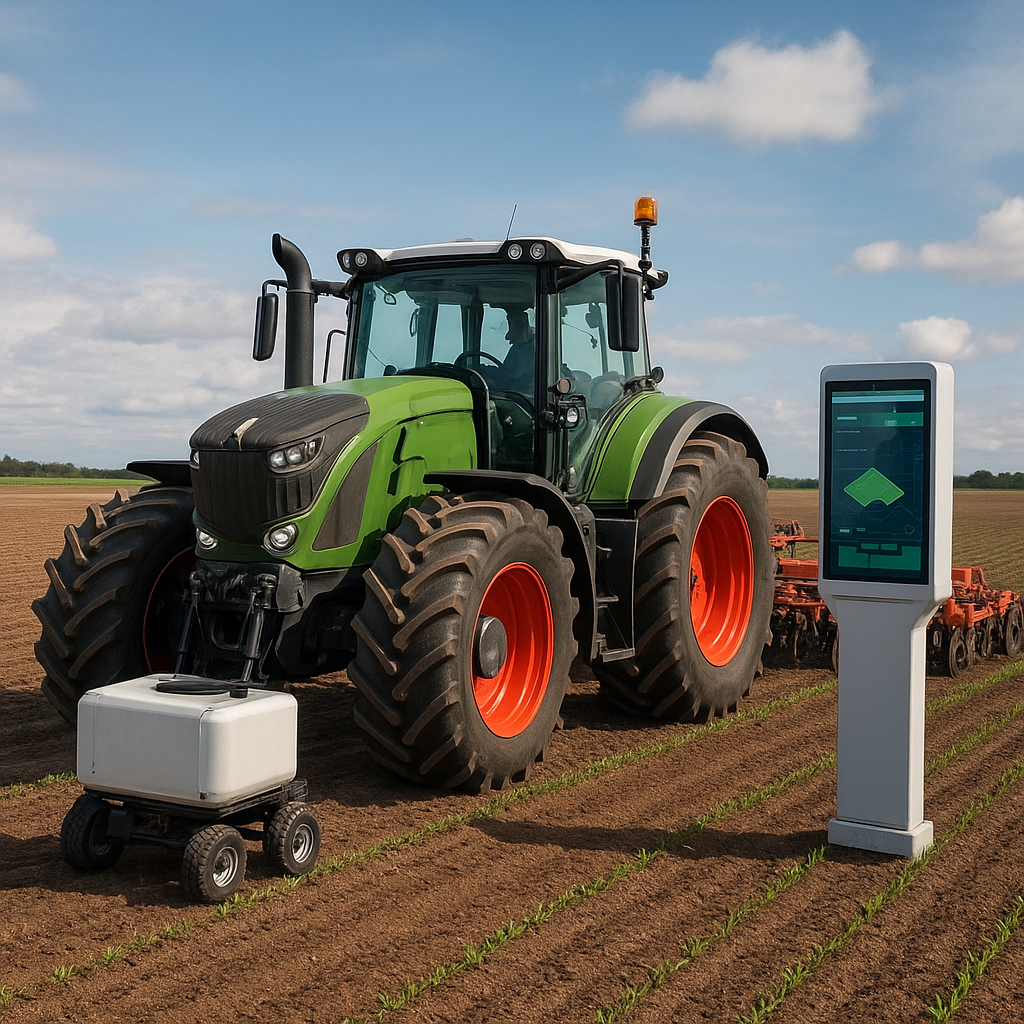
The next step beyond guidance is autonomy. Semi-autonomous tractors are already working on many farms, where the operator oversees the system and intervenes only when necessary. These machines can perform tasks like tillage or spraying along predefined routes, adjusting speed to match field conditions and obstacles detected by sensors.
Fully autonomous tractor concepts show that it is technically possible to remove the cab altogether and control the machine remotely from a tablet or control center. In practice, regulations, safety concerns and liability questions mean that many regions move cautiously. However, autonomy is steadily becoming a realistic element of large-scale operations and specialty crops that require repetitive tasks. Multiple smaller autonomous units working together may offer more flexibility and lower soil compaction than one huge tractor.
Safety remains critical. Modern systems rely on radar, lidar, ultrasonic sensors and 360-degree cameras to detect obstacles and humans. Redundant braking and steering systems help prevent accidents. For many farms, the most practical near-term approach is supervised autonomy, where an operator monitors several tractors or robots simultaneously, intervening when alerts occur.
Telematics and connected fleet management
Connectivity is another defining trend. Tractors equipped with telematics modules can send real-time data to cloud platforms. Fleet managers monitor machine position, fuel level, work progress and error codes from any location. This capability supports better logistics, for example, coordinating grain carts during harvest or reorganizing tasks when weather changes.
Connected tractors can share work records directly with farm management software. Hours of operation, field boundaries, tasks completed and input rates are automatically captured. Maintenance becomes more proactive: dealers or service teams receive alerts about emerging problems, schedule service visits and update software remotely. This reduces downtime and prevents small issues from turning into expensive failures.
Telematics also improves transparency in custom work and contractor operations. Clear digital records make billing easier and reduce disputes about time spent or hectares covered. Over time, the data builds a history that helps evaluate machine utilization, support investment decisions and fine-tune the assignment of tractors to specific implements and fields.
Smart implements and ISOBUS integration
Tractor technology trends cannot be separated from implement innovation. The rise of standardized communication protocols, particularly ISOBUS, allows tractors and implements from different manufacturers to exchange data. With an ISOBUS terminal in the cab, one screen can control many tools, simplifying the operator’s environment and reducing confusion.
Smart implements use sensors and controllers to adjust working depth, fan speed, row shut-off or application rate in real time. When combined with tractor guidance and task controllers, the system can switch sections on and off automatically, prevent double application and respond to variable-rate prescriptions. This synergy turns the tractor-implement pair into a **coordinated** system that reacts dynamically to field variability.
The concept of “tractor-implement management” is gaining importance. In this approach, the implement can actually command certain tractor functions, such as forward speed or PTO power, to maintain optimal performance. For example, a baler may slow the tractor in heavy crop to ensure proper bale density, or a planter may stop seeding when speed exceeds a preset limit that could compromise depth control.
Electrification and alternative powertrains
Environmental sustainability and energy efficiency are reshaping tractor design. While diesel remains dominant, manufacturers increasingly explore electrification and alternative fuels. Hybrid systems, where an electric motor assists the diesel engine, can smooth power delivery, recover energy in certain operations and improve fuel economy.
Battery-electric tractors are emerging for lower power ranges and shorter duty cycles, such as in horticulture, livestock facilities and municipal work. These machines offer quiet operation, instant torque and zero local emissions. Their main limitations are battery capacity, charging infrastructure and purchase price. Nevertheless, technological progress is rapid, and total cost of ownership can be attractive in some scenarios, especially when electricity is affordable or produced on-farm with solar.
Other powertrains include compressed natural gas, liquefied natural gas and renewable fuels like HVO. Some prototypes explore hydrogen fuel cells, which generate electricity on board while emitting only water. Each alternative presents different trade-offs in terms of infrastructure, range and maintenance. Over time, diverse solutions will likely coexist, tailored to specific farm sizes, tasks and regional policies.
Soil protection and smart traction management
As tractors grow stronger, soil compaction becomes a serious concern. Modern technology addresses this with better traction management and weight distribution. Continuously variable transmissions and advanced drive systems allow the tractor to operate at the most efficient engine speed, delivering just enough torque to the wheels or tracks without excessive slip.
Central tire inflation systems let operators adjust tire pressure from the cab according to field or road conditions. Low pressure and larger footprints in the field reduce compaction and improve traction, while higher pressure on the road protects tires and cuts rolling resistance. Track systems, whether on the tractor or on implements, spread weight across a larger surface, protecting soil structure.
Real-time slip monitoring, load sensing and draft control help match drawbar power to conditions. When combined with guidance and prescription maps, tractors can follow traffic lanes or controlled traffic farming patterns, confining heavy loads to specific tracks. This protects the rest of the field, supporting better root growth and water infiltration, which are essential for long-term **productivity**.
Human-centered cab design and ergonomics
Even as automation increases, the human operator remains vital. Manufacturers focus heavily on cab comfort, visibility and intuitive interfaces. Air-suspended seats, climate control, low noise levels and optimized joystick layouts reduce fatigue during long field days. Large glass areas, high-mounted cameras and mirror systems minimize blind spots, improving safety around people, animals and obstacles.
Customizable control profiles allow each operator to configure how buttons, levers and screens respond. This is especially useful on farms with multiple drivers or for contractors switching between tasks. Support systems, such as on-screen tutorials, context-sensitive help and guided setup wizards, make it easier to configure complex implements correctly. The goal is not only to increase comfort but also to ensure that operators actually use the full capabilities of modern **technology** rather than ignoring features because they seem too complicated.
Data, analytics and decision support
Modern tractors generate a continuous stream of operational data. Location, speed, fuel consumption, engine load, error codes and implement activity are all recorded. When combined with yield maps, soil tests and weather records, this data forms the basis for powerful analytics. Farms can compare performance across fields, operators or seasons, identify bottlenecks and verify the effect of agronomic decisions.
Decision support tools build on this information to suggest optimal seeding dates, field sequences, application rates or machinery combinations. Some systems simulate different scenarios, helping farmers plan workflows under various weather forecasts. The tractor becomes a key node in a larger **information** ecosystem, feeding accurate field-level data into planning and financial analysis.
Data ownership and privacy are critical topics. Farmers need clear agreements about who can access machine-generated data and how it may be used. Transparent policies, offline export options and interoperability standards help ensure that operators retain control. As regulations evolve, the value of trustworthy, well-structured data will only increase, supporting traceability, certification and compliance requirements.
Modularity, scalability and lifecycle management
Another important trend is modular design. Tractors are increasingly engineered so that key components, such as terminals, communication modules and guidance hardware, can be upgraded without replacing the entire machine. This makes it easier to scale technology as needs grow and budgets allow. A farm might start with steering assistance and later add section control, telematics and variable-rate capabilities to the same base tractor.
Lifecycle management focuses on total cost of ownership rather than just purchase price. Predictive maintenance, detailed cost tracking, fuel efficiency monitoring and residual value analysis inform replacement strategies. High-quality remanufactured components and software updates extend the useful life of machinery. Some business models experiment with “tractor-as-a-service” or power units that can be leased for peak seasons, matching capacity to workload.
Scalability also applies to farm structures. Smallholders can benefit from compact, multi-purpose tractors with plug-and-play technology, while large operations may invest in highly specialized machines dedicated to specific tasks. The challenge for manufacturers and advisors is to design solutions that grow with the user, avoiding both underutilization and overinvestment.
Environmental performance and regulatory pressure
Emissions standards for off-road machinery continue to tighten, driving the adoption of cleaner engines and exhaust after-treatment systems. Advanced combustion control, high-pressure fuel injection and selective catalytic reduction reduce pollutants significantly compared to earlier generations. At the same time, enhanced fuel efficiency directly lowers operating costs.
Beyond engine emissions, regulators and markets increasingly focus on carbon footprints, biodiversity and water quality. Tractors play a role through reduced tillage, precise nutrient placement and accurate pesticide application. When guidance, section control and variable-rate systems work together, they lower over-application and off-target losses. This not only supports compliance but also demonstrates environmental stewardship to consumers and supply chain partners.
Many sustainability certification schemes require documentation of field operations. Connected tractors simplify this by automatically recording who did what, where and when. These digital logs can support audits, eco-schemes and participation in carbon or ecosystem service markets, turning careful management into measurable value.
Future outlook: integration and collaboration
The future of tractor technology lies in deeper integration and collaboration across the entire farm system. Rather than thinking of tractors, implements, sensors and software as separate purchases, more farmers will design integrated solutions around their specific crops, climates and market channels. Open standards and interoperable platforms will be essential so that different brands and tools can work together seamlessly.
Artificial intelligence is likely to increase its role in interpreting machine data, adjusting settings automatically and proposing optimal strategies. Tractors may communicate directly with weather stations, soil sensors and storage facilities, making coordinated decisions about when to harvest, irrigate or apply nutrients. Human expertise will remain central, but machines will handle more repetitive analysis and real-time control.
As this evolution continues, the tractor’s identity will keep shifting—from simple power source to **strategic** hub of a connected, sustainable and resilient farm. Farmers who understand and selectively adopt these trends will be better positioned to manage risk, control costs and capture new opportunities in a rapidly changing agricultural landscape.