Managing a modern tractor fleet requires harnessing vast amounts of data to improve performance, reduce costs, and ensure safety across agricultural operations. By leveraging advanced telemetry and analytics, fleet managers can transform raw numbers into actionable insights. This article explores key strategies for effective tractor fleet data management, covering methods of real-time data gathering, integration platforms, sophisticated analysis, and proactive maintenance approaches.
Data Acquisition and Telemetry Systems
Collecting reliable information begins with robust hardware and communication networks. Tractors equipped with built-in sensors, telematics modules, and GPS units send streams of data about machine status, location, and environmental conditions. Core elements include:
- Engine diagnostics – monitoring temperature, oil pressure, and RPMs.
- Fuel consumption tracking – measuring usage rates to optimize efficiency.
- Positioning data – capturing field paths, boundary outlines, and geofencing alerts.
- Implement performance – assessing attachment loads, depth control, and ground pressure.
- Operator behavior – recording idling time, speed variations, and shift patterns.
High-frequency sampling and real-time data transfer enable fleet managers to respond quickly to issues like overheating or geo-violations. Wireless networks (4G/5G), satellite links, or even LoRaWAN solutions ensure connectivity across vast and remote tracts of land. Implementing fail-safes and local data caching reduces risks of information loss.
Data Integration and Centralized Storage
Once data is captured, a scalable, cloud-based platform unifies disparate streams into a single repository. Centralized storage offers these advantages:
- Standardization – converting sensor outputs and proprietary formats into uniform schemas.
- Accessibility – providing role-based dashboards and mobile apps for remote users.
- Scalability – handling rapidly growing fleets without performance bottlenecks.
- Security – using encryption, access controls, and audit logs to safeguard sensitive data.
- Integration APIs – allowing linkage with ERP, supply chain, and third-party agronomy systems.
Effective data models classify records by timestamp, machine ID, parameter type, and geographical tags. Data warehousing solutions often employ time-series databases for sensor values and relational tables for maintenance logs. Hybrid strategies combine on-premise gateways for local preprocessing with off-site cloud servers for long-term retention.
Advanced Analytics and Reporting
Centralized datasets become valuable only once analyzed. Employing a mix of descriptive, diagnostic, and predictive analytics uncovers hidden patterns in tractor utilization and maintenance requirements. Key analytical techniques include:
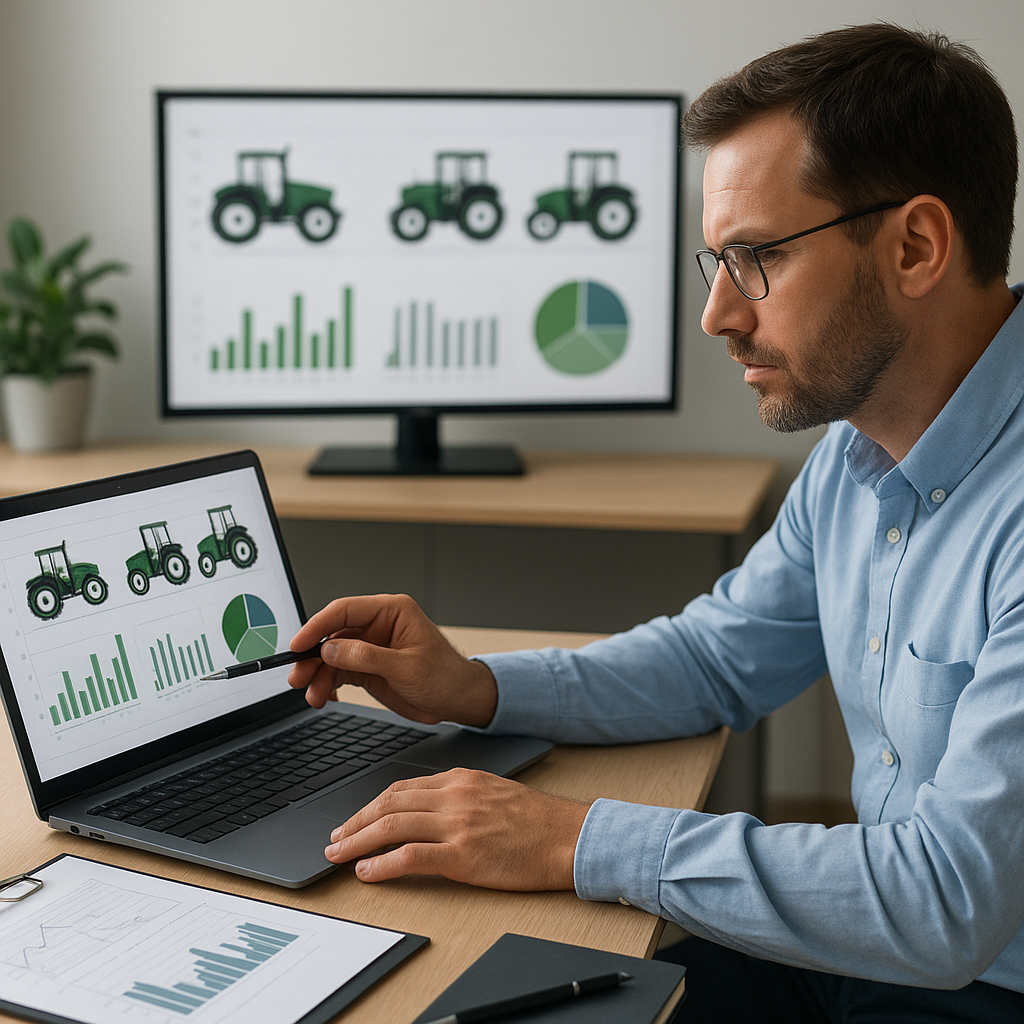
- Dashboard visualizations – tracking fuel trends, operating hours, and work completed.
- Alert generation – notifying managers of anomalies like sudden drops in oil pressure.
- Comparative benchmarking – evaluating performance across machines, operators, and fields.
- Machine learning models – forecasting component failures and unscheduled downtime.
- Geo-analytics – mapping coverage gaps and optimizing field routes to reduce overlap.
Interactive reporting tools let supervisors customize KPIs such as average fuel burn per hectare or downtime incidents per 1,000 operating hours. Integrating weather data further refines predictive accuracy by correlating humidity and soil moisture with equipment strain. Visual cues, color-coded heat maps, and drill-down capabilities help pinpoint inefficiencies.
Proactive Maintenance and Lifecycle Management
Shifting from reactive to predictive maintenance maximizes uptime and minimizes repair expenses. Instead of waiting for breakdowns, advanced algorithms analyze trends in vibration, temperature, and hydraulic pressures to anticipate failures days or weeks ahead. Components often monitored include:
- Engine air filters – pressure differentials indicating clogging.
- Transmission gears – vibration signatures pointing to wear.
- Hydraulic pumps – flow rate fluctuations suggesting seal leaks.
- Track assemblies or tires – tread depth and alignment measurements.
Establishing maintenance schedules based on actual usage rather than fixed intervals ensures servicing whenever necessary, not just on calendar days. Automated work order generation and parts ordering streamline logistics. When combined with optimization algorithms, fleet managers can sequence mechanic assignments, reduce spare parts inventory, and lower total cost of ownership.
Optimizing Fleet Utilization and Field Operations
Beyond machine health, data-driven insights enhance overall farm productivity. By analyzing route efficiency, fertilizer spread patterns, and harvester yield maps, managers can:
- Minimize overlap and missed spots during seeding or spraying.
- Balance workload distribution across tractors to prevent overuse.
- Adjust field boundaries and orientations based on soil quality gradients.
- Plan refueling or rest breaks without disrupting critical tasks.
Leveraging real-time coordination with operators via in-cab displays improves responsiveness to changing field conditions, such as unexpected rainfall or pest infestations. Integration with weather forecasting services and remote sensing data supports dynamic decision-making, ensuring that each tractor performs the right job at the optimal moment.
Security, Compliance, and Data Governance
As fleets rely more on connected devices, cybersecurity becomes paramount. Best practices include:
- Encrypting data in transit and at rest.
- Implementing multi-factor authentication for system access.
- Regularly updating firmware to patch vulnerabilities.
- Maintaining audit trails for regulatory compliance, such as pesticide usage logs or environmental reporting.
- Establishing clear data ownership and retention policies.
Robust governance frameworks assign responsibilities for data quality, privacy, and ethical usage. Ensuring that only authorized personnel can view sensitive operational metrics prevents misuse. Periodic risk assessments and penetration testing safeguard against emerging threats.
Scaling and Future Trends
As technology evolves, tractor fleet management platforms will incorporate advanced features like autonomous driving, edge computing, and blockchain-based supply chain verification. Integrating emerging Internet of Things (IoT) devices—drones, soil sensors, weather stations—will provide richer context for decision-making. Scalable architectures built on microservices and containerization enable rapid feature deployment, while AI-driven assistants guide managers through complex analyses.
By staying ahead of technological advancements and continually refining data practices, agricultural enterprises can maintain a competitive edge. Embracing a culture of efficiency, innovation, and continuous improvement ensures that every tractor in the fleet contributes to optimal farm performance and sustainable growth.